
Aviator is a crash game from Spribe, a studio founded in August 2018 in Tbilisi, Georgia. The game launched in January 2019 and went live on Adjarabet in February 2019. Each round shows a rising multiplier curve that can crash at any moment. Small bankrolls feel that crash faster than big ones. This article covers three controls: the 2% stake rule, low stakes, and session limits.
The math is fixed. RTP sits at 97%, so the house edge is 3% on every bet. No strategy removes that edge. What you control is variance: how much you stake, when you cash out, and when you stop. A $20 bankroll with the right settings can last an evening. The same $20 without settings can vanish in ten rounds.
Aviator round mechanics
A round lasts about 8 to 30 seconds. Roughly 1 in 33 rounds crashes instantly at 1.00x, before any player can react. Between rounds there are only a few seconds to place the next bet.
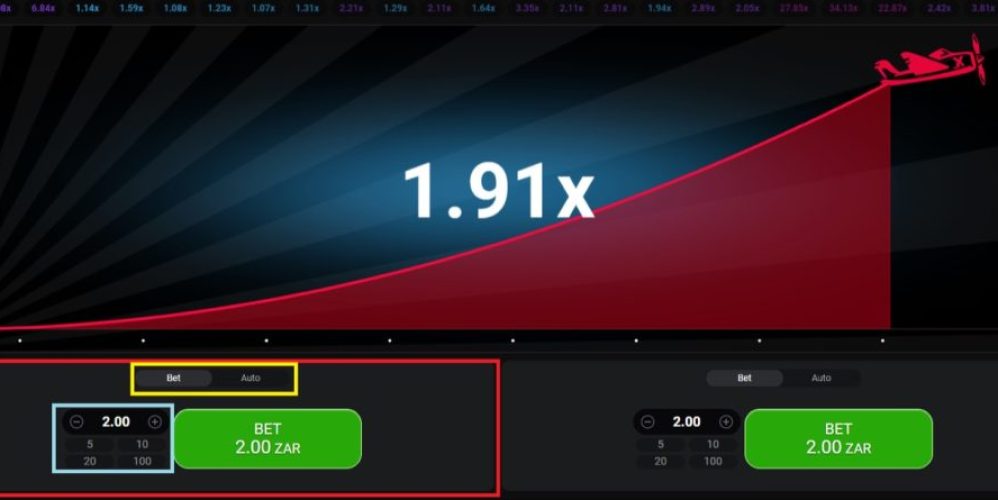
Here is one round with real numbers. You stake $0.20. The plane climbs to 1.91x. You hit cash-out and collect $0.38, which is $0.18 profit. If the round crashes at 1.92x before you act, you lose the full $0.20. The cash-out request must reach the server before the crash, or the stake is gone.
The result is not decided mid-flight. Before each round, the server publishes a SHA-256 hash of the server seed, client seeds from players are combined, and the crash point is fixed before take-off. Inputs are revealed after the round, and you can check them with the verification tool inside the game. Neither the operator nor Spribe can change a result after the round starts.
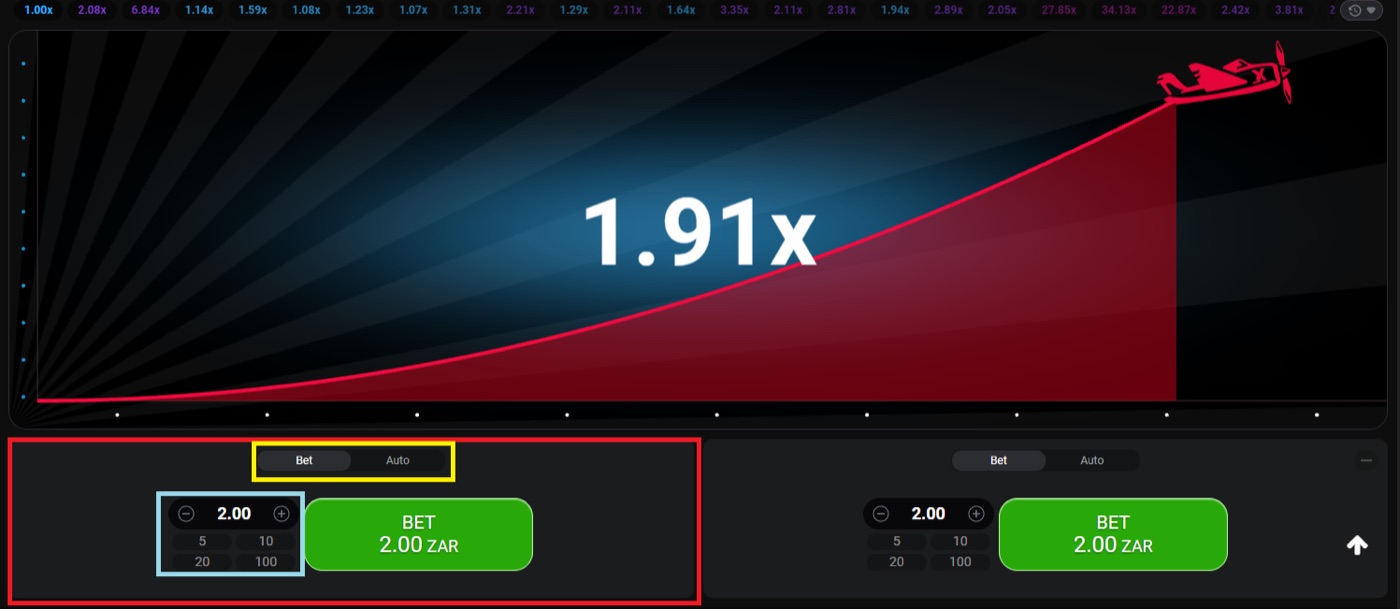
A desktop round at 1.91x with both bet panels active.
The interface gives a small bankroll several useful tools:
- Two bet panels per round, each with a separate cash-out.
- Auto Cash-Out at a preset multiplier.
- Round history of previous multipliers at the top.
- A live bets panel with All Bets, My Bets and Top tabs.
- In-game chat and a Provably Fair badge.
The 2% stake rule
Strategy guides cap one stake at 2% of the bankroll. A $10 bankroll makes the round stake $0.20. The rule is simple division: bankroll times 0.02 equals your maximum bet.
Why 2%? Because losing streaks are normal in a high-variance game. At 2% per round, you survive 50 consecutive losses before the balance hits zero. At 10% per round, the same streak empties the account in 10 rounds. The edge stays 3% either way. The rule buys time, not profit.
| Bankroll | 2% stake | 5% stake | Losses to zero at 2% |
|---|---|---|---|
| $5 | $0.10 | $0.25 | 50 |
| $10 | $0.20 | $0.50 | 50 |
| $25 | $0.50 | $1.25 | 50 |
| $50 | $1.00 | $2.50 | 50 |
| $100 | $2.00 | $5.00 | 50 |
The minimum stake matters here. Typical stakes run from about $0.10 per bet, though the exact minimum depends on the operator. Some bookmakers accept local-currency minimums as low as R1, KES 2 or ₦1. On a $5 bankroll, a $0.10 minimum fits the 2% rule exactly.
Apply the rule in this order:
- Decide your bankroll before depositing, and treat it as spent money.
- Multiply by 0.02 to get the round stake.
- Enter that stake manually instead of tapping quick-stake buttons.
- Recalculate only when the bankroll changes by a clear amount.
- Never raise the stake to chase a loss.
That last point kills Martingale. Martingale doubles the stake after each loss and reaches 1,024 times the base stake after 10 losses. A $0.20 start becomes a $204.80 bet. Guides warn against it, and Fibonacci and D’Alembert fail the same way: none of them beats the 3% edge.
Low stakes and cash-out targets
Stakes typically start near $0.10 per bet, though the exact minimum depends on the operator. Auto Cash-Out lets you fix an exit multiplier before the round starts. For a small bankroll, low targets do the heavy lifting.
The probability of reaching a multiplier m is 0.97 divided by m. The numbers:
- 1.5x: 64.7% of rounds.
- 2x: 48.5% of rounds.
- 3x: 32.3% of rounds.
- 5x: 19.4% of rounds.
- 10x: 9.7% of rounds.
- 20x: 4.85% of rounds.
Expected value is -3% of the stake at every cash-out target. Cashing at 1.5x is not safer in expectation; it only swaps rare big losses for frequent small wins. Strategy changes variance, not the edge. Guide canon suggests auto cash-out at 1.5x to 2x, and 1.3x to 1.5x wins roughly 65 to 75% of rounds.
The two-bet split uses both panels. Bet one: $0.20 auto-cashed at 1.5x. Bet two: $0.20 left to ride toward 5x or 10x. The first bet covers the second when it lands. Realistic long targets sit between 5x and 50x; a 50x hit lands in 1.94% of rounds.
Some players read aviator game history pages before their first deposit. The deposit math above matters more than any backstory. Rounds are independent, so pattern charts, graph analysis and “best time to play” claims do not change the odds.
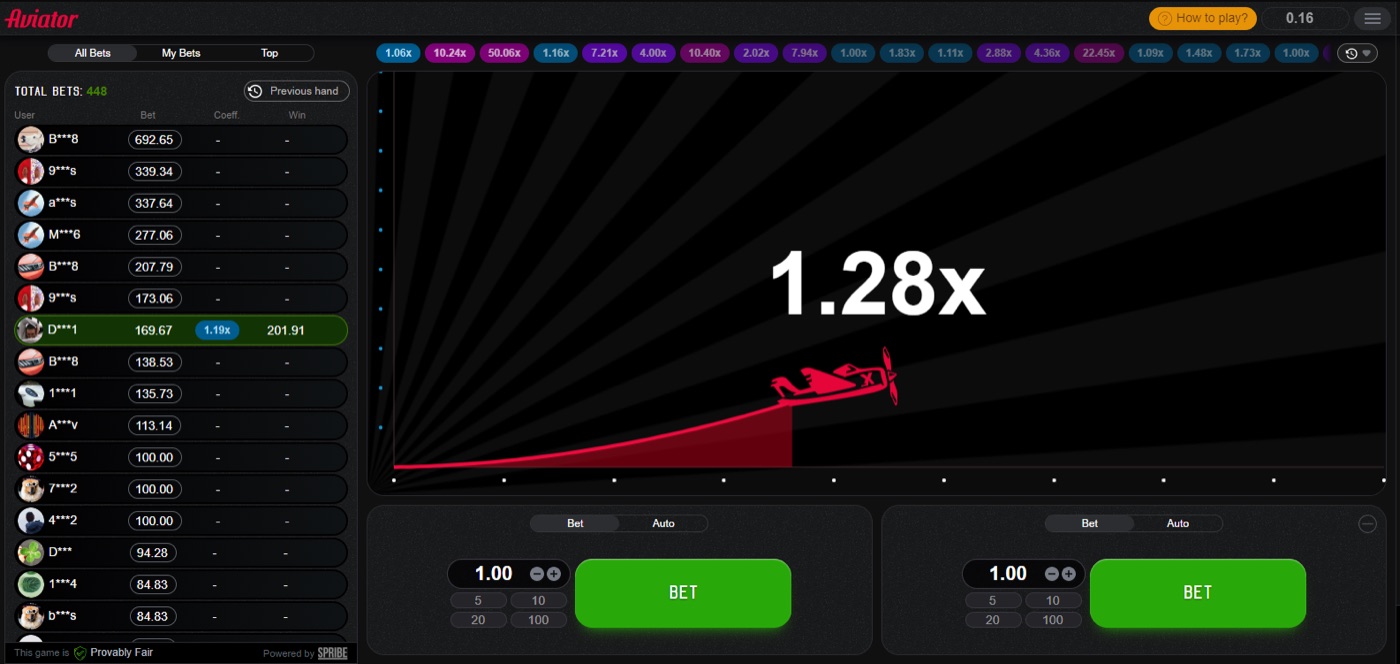
The plane in flight while the multiplier climbs past the low cash-out targets.
Session limits and autoplay
Auto Play runs 10 to 100 rounds with stop-on-win and stop-on-loss settings. A $20 bankroll with a $6 stop-loss has a fixed exit built in. Set the numbers before the first round, not after a bad one.
A concrete session plan: bankroll $20, stake $0.40 per round, stop-loss $6, win goal $8, time cap 60 minutes. At 60 to 90 rounds per hour, one hour produces $24 to $36 in turnover. Expected loss on that turnover at 3% is $0.72 to $1.08. Turnover is not loss, but it shows why long sessions grind small balances down.
A workable set of session rules:
- Stop-loss: quit when the balance drops by a set amount.
- Win goal: quit when the balance rises by a set amount.
- Time cap: one hour, then log out whatever the balance says.
- No redeposit: a busted session ends the day.
- Autoplay stop settings mirror the same two numbers.
Connection quality is a real cost. Cash-out time-outs come from latency or a slow device, and the request must reach the server before the crash. Aviator 2.0, released on 15 August 2019, made the game 40% faster and lighter for slow connections and low-end phones. Playing off-peak gives a smoother connection, not better odds. If a session stops being affordable, stop playing and use the operator’s limit tools.
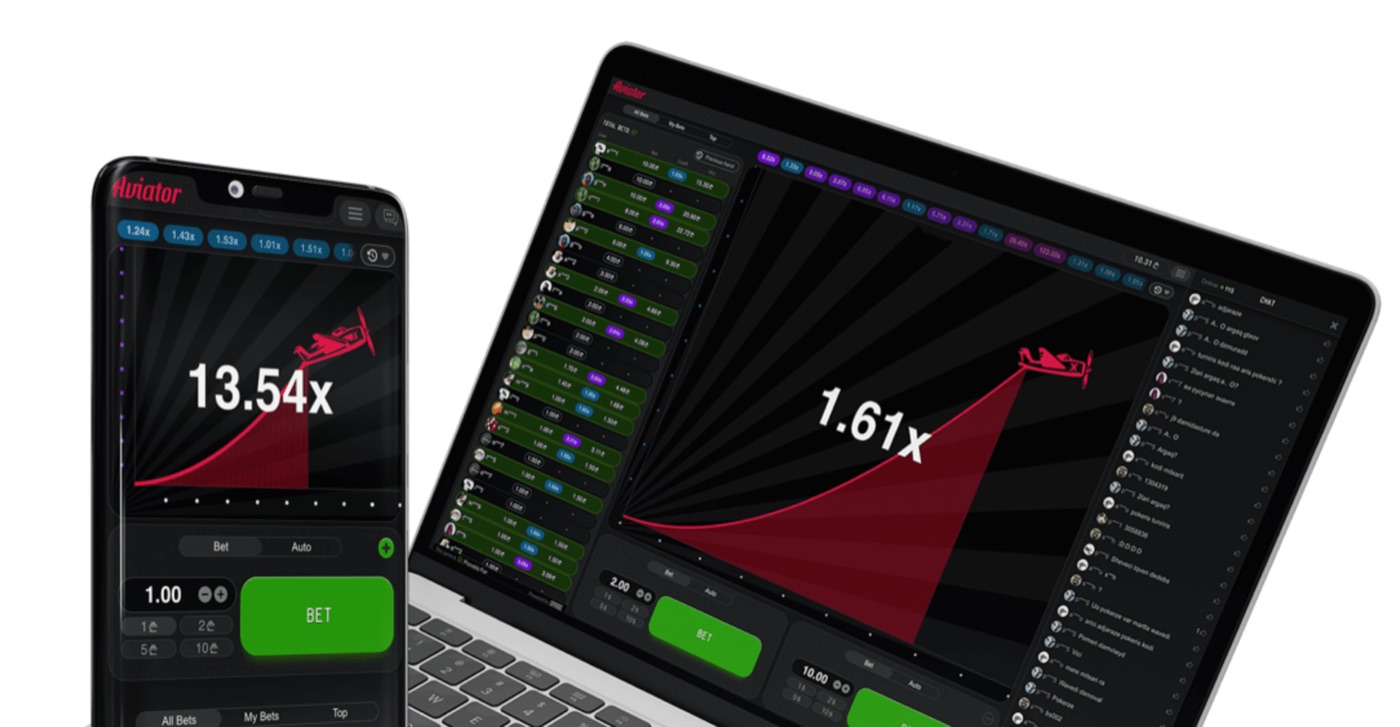
Aviator on a phone and a laptop; the game is built for low bandwidth and budget devices.
Demo mode and free bets
Demo mode needs no registration and runs in desktop, tablet and mobile browsers. Rain Promo drops free bets into the chat for the first players to tap claim. Both tools suit a small bankroll because they cost nothing.
Free bets are granted by operators individually, in batches or by API, and operators announce promos in the chat. Tournaments and races with leaderboards exist too, but chasing leaderboard volume with a $10 bankroll is a fast way to bust it.
Use the demo to rehearse the exact setup you will play for real:
- Test the 2% stake on a virtual balance the size of your real one.
- Run 50 rounds at a 1.5x auto cash-out and note the drawdowns.
- Try the two-bet split and watch how often the safe leg carries the risk leg.
- Practice hitting cash-out manually so latency does not surprise you.
Why predictors fail small bankrolls
Spribe publishes no standalone official Aviator app. The server publishes a SHA-256 hash of the server seed before each round, which commits the crash point in advance. Prediction is impossible for that reason.
The “Aviator” and “Aviator Predictor” apps on Google Play, Softonic, Uptodown and APK mirrors are third-party clones, some with “virtual coins, no real value” disclaimers or ads. Version names like “Predictor v4.0” or “v12” are marketing, not products. Telegram signal bots resell public math. Hollywoodbets tells players not to spend money on Aviator predictors.
For a small bankroll the logic is blunt. Money spent on a predictor APK or a signal subscription is an immediate, guaranteed loss. That same money at 2% stakes is dozens of real rounds. The only prediction tools that work are the stake cap, the auto cash-out and the stop-loss.
Aviator FAQ
Aviator reached over 300 operators by December 2020. The game has no bonus round and no slot reels. These are the questions small-bankroll players ask most.
What is the 2% rule in Aviator?
It caps each round stake at 2% of your total bankroll. With $10 you bet $0.20; with $50 you bet $1. The rule survives 50 straight losses and stops one bad streak from ending the session.
Can I play Aviator for free?
Yes. Demo mode runs on the operator site or at demo.spribe.io and needs no registration. Rain Promo also drops free bets into the chat, and operators grant free bets individually, in batches or by API.
Is there an app that can predict Aviator?
No. The crash point is committed by hash before the round starts, so prediction is impossible. Predictor APKs and Telegram signal bots are third-party products, and Hollywoodbets tells players not to spend money on them.
What cash-out multiplier suits a small bankroll?
Guide canon points to 1.5x to 2x on auto cash-out, with 1.3x to 1.5x winning roughly 65 to 75% of rounds. Expected value stays -3% at every target, so low targets smooth variance rather than create profit.
Why did my cash-out time out?
Latency or a slow device. The cash-out request must reach the server before the crash, and rounds move fast. A lighter build, off-peak play and a stable connection reduce time-outs; they do not change the odds.
How many rounds can a small bankroll cover?
At 2% per round, 50 consecutive losses empty the balance. At 60 to 90 rounds per hour, a typical one-hour session involves 60 to 90 stakes, so the 2% rule with a stop-loss is what keeps a small bankroll alive across the hour.